Variable Speed Screw Air Compressors for Industrial Air Demand
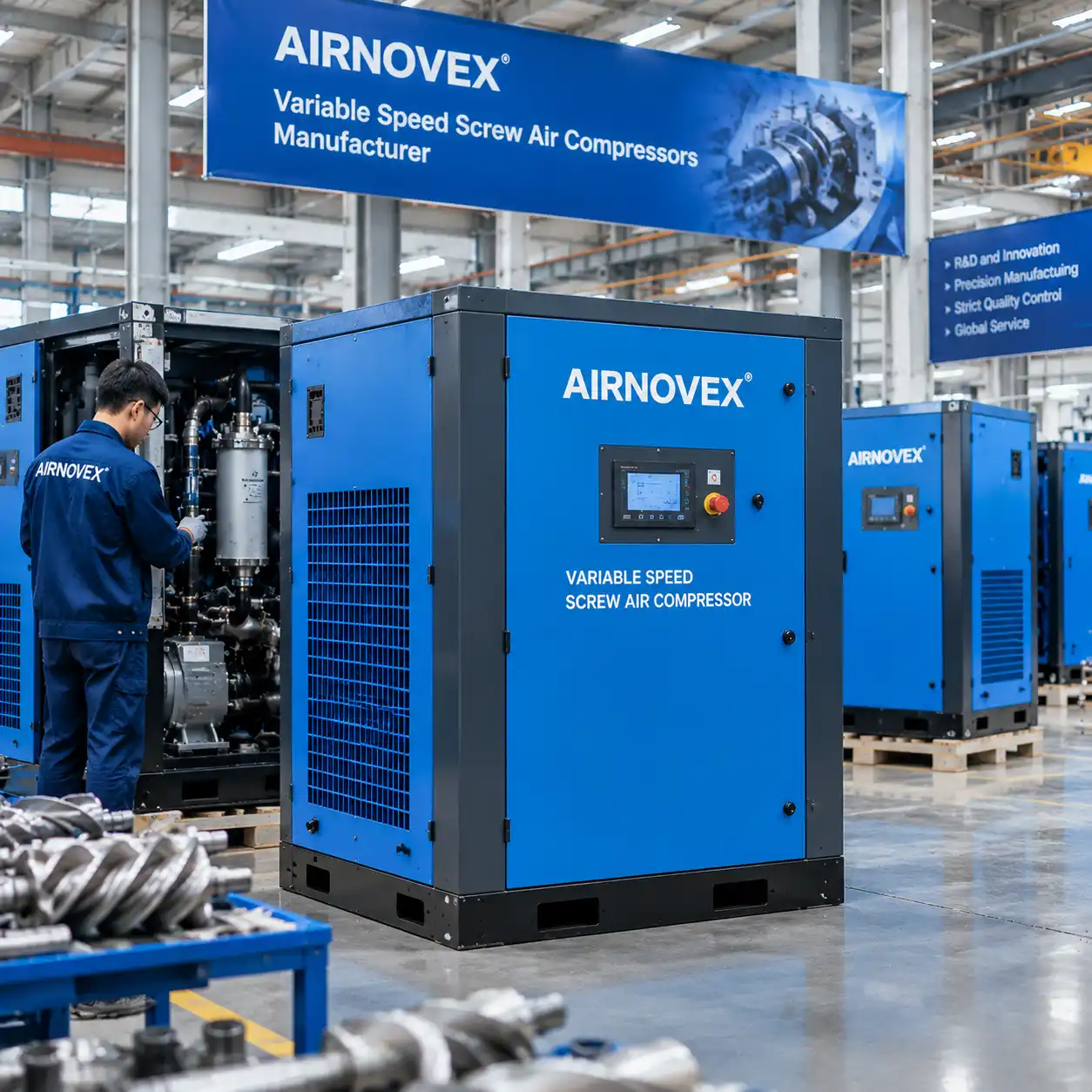
A variable speed screw air compressor uses a variable frequency drive (VFD) to adjust motor speed as compressed-air demand changes. For plants that do not consume the same amount of air all day, this allows compressor output to follow production demand more closely than a conventional fixed-speed machine operating only through load/unload control.
AIRNOVEX supplies variable speed screw air compressors for manufacturing plants, machine shops, automotive production, metalworking, packaging, textiles, electronics and other industrial facilities. Available configurations include permanent magnet variable speed compressors, single-stage screw compressors, two-stage compression systems and complete compressed-air packages with air treatment equipment.
10–295 HP
87–181 PSI
Approx. 1,236 CFM
Two-Stage / Integrated
A VSD compressor is usually a good fit when:
- air consumption rises and falls during a normal shift;
- several production lines start and stop independently;
- the existing compressor spends significant time unloaded;
- pressure swings affect production equipment;
- the plant needs one compressor to cover a broad operating range.
A fixed-speed compressor may still make sense when:
- air demand remains close to full load for most operating hours;
- the compressor will operate mainly as a base-load machine;
- a separate VSD unit already handles trim demand;
- the simpler initial equipment cost is more important than modulation.
Built Around Variable Plant Demand
The main reason to specify a VSD screw compressor is not simply that it has an inverter. What matters is how the motor, air-end and control system work together when plant demand moves away from full load.
Variable Frequency Drive
The drive changes motor speed within the compressor's approved operating range, allowing delivered airflow to respond to changing system demand.
Permanent Magnet Motor Options
PM motor configurations are available for applications that require variable-speed operation and compact integration between the motor, drive and screw compressor package.
Rotary Screw Air-End
Continuous rotary compression is suited to industrial plants that need dependable compressed air over long daily operating periods.
Pressure-Based Control
System pressure is monitored by the controller, which adjusts compressor output as plant air consumption changes.
Controlled Starting
Motor acceleration is managed through the variable frequency drive rather than an abrupt across-the-line start.
Industrial Cooling Package
Air-cooled configurations are available for industrial installations. Compressor-room ventilation and cooler cleanliness remain important to reliable operation.
Variable Speed Screw Air Compressor Specifications
The following range is based on current manufacturing-platform reference data for variable speed screw compressors. Final airflow changes with operating pressure and model configuration, so the exact AIRNOVEX datasheet should be confirmed before an order is placed.
| Motor Power | Approx. HP | Reference Max. Flow | Approx. CFM | Noise dB(A) | Air Outlet | Dimensions L × W × H | Weight |
|---|---|---|---|---|---|---|---|
| 7.5 kW | 10 HP | 1.2 m³/min | 42 CFM | 62 ± 2 | 1/2 | 900 × 600 × 850 mm | 130 kg |
| 11 kW | 15 HP | 1.7 m³/min | 60 CFM | 62 ± 2 | 3/4 | 1000 × 700 × 1000 mm | 210 kg |
| 15 kW | 20 HP | 2.6 m³/min | 92 CFM | 62 ± 2 | 3/4 | 1000 × 700 × 1000 mm | 210 kg |
| 22 kW | 30 HP | 3.6 m³/min | 127 CFM | 62 ± 2 | 1 | 1300 × 790 × 1150 mm | 310 kg |
| 30 kW | 40 HP | 5.2 m³/min | 184 CFM | 62 ± 2 | 1 | 1300 × 790 × 1150 mm | 330 kg |
| 37 kW | 50 HP | 6.3 m³/min | 222 CFM | 62 ± 2 | 1-1/2 | 1400 × 950 × 1310 mm | 470 kg |
| 45 kW | 60 HP | 7.2 m³/min | 254 CFM | 63 ± 2 | 1-1/2 | 1400 × 950 × 1310 mm | 610 kg |
| 55 kW | 75 HP | 9.8 m³/min | 346 CFM | 63 ± 2 | 2 | 1900 × 1250 × 1600 mm | 960 kg |
| 75 kW | 100 HP | 12.5 m³/min | 441 CFM | 66 ± 2 | 2 | 1900 × 1250 × 1600 mm | 1040 kg |
| 90 kW | 120 HP | 15.5 m³/min | 547 CFM | 66 ± 2 | 2 | 2000 × 1250 × 1880 mm | 1220 kg |
| 110 kW | 150 HP | 19.8 m³/min | 699 CFM | 70 ± 2 | DN65 | 2400 × 1450 × 2030 mm | 1600 kg |
| 132 kW | 175 HP | 23.5 m³/min | 830 CFM | 70 ± 2 | DN65 | 2400 × 1450 × 2030 mm | 1520 kg |
| 160 kW | 215 HP | 28.0 m³/min | 989 CFM | 72 ± 2 | DN80 | 2400 × 1450 × 2030 mm | 1800 kg |
| 185 kW | 250 HP | 31.0 m³/min | 1095 CFM | 72 ± 2 | DN80 | 3000 × 1580 × 2150 mm | 2500 kg |
| 220 kW | 295 HP | 35.0 m³/min | 1236 CFM | 72 ± 2 | DN80 | 3000 × 1580 × 2150 mm | 2600 kg |
Reference operating pressure range: 0.6–1.25 MPa / 6–12.5 bar / approximately 87–181 PSI. Actual free air delivery, dimensions, connection standard, noise level, motor configuration and weight should be confirmed against the final model and selected operating pressure.
Variable Speed vs. Fixed-Speed Screw Compressors
Both technologies have a place in an industrial compressed-air system. The better choice depends mainly on how much the plant's air demand changes during operating hours.
| Operating Point | Variable Speed Screw Compressor | Fixed-Speed Screw Compressor |
|---|---|---|
| Motor speed | Changes within the approved operating range | Runs at essentially one operating speed |
| Air delivery | Adjusts with plant demand | Normally managed through load/unload control |
| Variable demand | Well suited to changing loads | May spend more time unloaded if oversized |
| Stable high demand | Operates normally, but the VSD may provide less economic benefit | Often a practical base-load choice |
| Starting | Controlled through the VFD | Depends on the motor starter arrangement |
| Pressure control | Can maintain a tighter pressure band | Usually operates across a load/unload pressure band |
| Control system | Includes drive electronics and variable-speed control | Simpler motor-speed architecture |
| Typical role in a multi-compressor room | Trim compressor for changing demand | Base-load compressor |
In a plant with several compressors, combining fixed-speed base-load machines with one variable speed trim compressor can make more sense than replacing every unit with a VSD model. The right arrangement depends on minimum demand, average demand, peak demand and required redundancy.
AIRNOVEX Compressor Configurations
Single-Stage PM VSD
For general industrial plants with changing demand and long daily operating hours.
Two-Stage Variable Speed
Available for higher-duty applications where a two-stage compression system fits the required airflow, pressure and operating profile.
Integrated Air Compressor
Compressor packages can be combined with selected air-treatment and storage equipment where installation space is limited.
Industrial Compressor Station
Multi-compressor systems can be configured around base-load capacity, trim capacity and standby requirements.
OEM Supply
Configuration discussions are available for distributors, importers and OEM customers with project-specific electrical, branding and documentation requirements.
Complete Air Treatment Package
Air receivers, refrigerated dryers, desiccant dryers and filtration can be matched to the compressor and required compressed-air quality.
Industrial Applications
Variable speed rotary screw compressors are most useful where production equipment creates noticeable differences between low, normal and peak compressed-air demand.
CNC Machining
Central air for tool changers, pneumatic clamping, air blast, actuators and other machine functions. VSD control is useful when machine utilization changes throughout the shift.
Metal Fabrication
Compressed air for pneumatic tools, automation, finishing equipment, cleaning and material-handling systems.
Automotive Manufacturing
Supports assembly tools, pneumatic controls, automated equipment, tire production and other processes with changing production loads.
Packaging
Used for cylinders, valves, conveyors, filling machinery and automated packaging lines that cycle according to production volume.
Electronics
Provides centralized compressed air for automated manufacturing and process equipment when downstream treatment is selected for the required air quality.
Textile Manufacturing
Suitable for plants where multiple machines or production lines operate at different loads during the day.
Plastics
Supplies automation, pneumatic valves, material handling and auxiliary equipment around molding and plastics production.
Food & Beverage
Compressor capacity must be paired with the correct drying and filtration system for the specific application and required air-quality level.
What We Need to Size Your Compressor
For a new compressor station, the most useful information is the amount of air your plant actually needs and the pressure required at the equipment. For an existing plant, measured demand is preferable to estimating capacity from motor horsepower alone.
Air Demand
- minimum compressed-air demand;
- normal operating demand;
- short-duration peak demand;
- required CFM or m³/min;
- daily and annual operating hours.
Site Conditions
- required PSI or bar at the point of use;
- plant voltage, phase and frequency;
- ambient temperature and compressor-room ventilation;
- altitude where relevant;
- required pressure dew point and filtration level.
Where Compressed-Air Energy Is Really Used
Variable speed control can reduce wasted power when compressor capacity regularly exceeds plant demand, but the drive cannot correct every source of compressed-air loss.
Compressor Room
- compressor sizing;
- load sharing between multiple machines;
- discharge pressure setting;
- cooler condition and ventilation;
- air-filter and separator condition;
- dryer and filter pressure drop.
Plant Distribution
- compressed-air leaks;
- undersized piping;
- restrictive fittings and valves;
- unnecessary high-pressure users;
- open blowing applications;
- poorly located or undersized storage.
This is why a credible energy comparison should use the plant's operating profile rather than a fixed advertised savings percentage. Two facilities using the same 100 HP compressor can have very different power costs if one runs close to full load while the other spends much of the day at partial demand.
A Complete Compressed Air System
The compressor is only the first part of the air system. Storage and air treatment should be selected at the same time because pressure drop, moisture removal and filtration all affect the pressure the compressor must produce.
A refrigerated dryer is commonly used for general manufacturing where a moderate pressure dew point is acceptable. Applications that require substantially drier air may need a desiccant dryer. Filtration should be selected according to the process instead of simply installing the finest possible filter, because unnecessary pressure drop increases compressor discharge pressure and operating cost.
Before You Order
Industrial compressors are often quoted by motor power, but the final purchase should be checked against the complete operating point. A 75 kW compressor selected at one pressure does not necessarily deliver the same airflow at another pressure.
Confirm Flow at Pressure
Compare compressor capacity at the PSI or bar the plant will actually use, not only the maximum pressure shown in a catalog.
Confirm Electrical Supply
Specify voltage, phase and frequency before production. Electrical requirements vary between the United States, Europe and other export markets.
Confirm Connection Standard
Outlet size alone does not confirm whether the final connection is NPT, BSP or a flange standard. Confirm the connection on the approved drawing.
Check Compressor-Room Heat
The installation must remove the heat rejected by the compressor. Poor ventilation can raise operating temperature even when the compressor itself is correctly sized.
Plan Service Access
Leave enough space around the package for cooler cleaning, filter replacement, lubricant service and electrical maintenance.
Match the Air Treatment
Dryer and filtration requirements should follow the process air-quality requirement rather than a one-size-fits-all package.
Questions Buyers Commonly Ask
What is a variable speed screw air compressor?
It is a rotary screw compressor that uses a variable frequency drive to change motor speed as compressed-air demand changes. Within its approved operating range, the compressor can reduce or increase airflow instead of relying only on full-load and unload operation.
Is VSD the same as VFD?
VFD refers to the variable frequency drive used to control an AC motor. VSD is the broader term for a variable speed drive system. In the screw compressor market, “VSD air compressor” and “VFD air compressor” are often used to describe the same type of variable-speed package.
Is a variable speed compressor always more efficient?
No. VSD compressors are particularly useful when air demand changes. A correctly sized fixed-speed compressor operating near full load for most of the day can also be efficient. The demand profile determines which approach makes more sense.
How much energy can a variable speed compressor save?
There is no single percentage that applies to every installation. The result depends on current compressor loading, unloaded running time, pressure, leaks, operating hours and how much plant demand varies. A useful comparison should estimate input power across the actual demand profile.
How do I choose the right CFM?
Start with the plant's normal and peak airflow at the required working pressure. If the facility already operates compressors, measured flow and load data are more useful than simply adding the theoretical consumption of every pneumatic device.
What pressure should I specify?
Use the lowest compressor discharge pressure that still provides sufficient pressure at the most demanding point of use after piping, dryer and filter losses are considered. Raising the entire plant pressure to solve one local pressure problem is usually an expensive approach.
What is the difference between single-stage and two-stage screw compression?
A single-stage compressor raises air from inlet pressure to final discharge pressure in one screw compression stage. A two-stage machine divides the pressure rise between two compression stages. Whether two-stage compression makes economic sense depends on required flow, pressure, annual operating hours and total lifecycle cost.
Can a variable speed screw compressor run continuously?
Rotary screw compressors are commonly used for long-duty industrial service. Reliable continuous operation still depends on correct sizing, ventilation, maintenance, lubricant condition, clean coolers and operation within the specified pressure and temperature limits.
Do I still need an air receiver with a VSD compressor?
In many systems, yes. An air receiver provides storage for short demand peaks, can help stabilize system behavior and supports moisture separation. Receiver size should be selected around the compressor capacity and the way the plant consumes air.
Can AIRNOVEX supply compressors for the U.S. market?
AIRNOVEX can review project-specific electrical and operating requirements for international installations. For a U.S. project, provide the required CFM, PSI, site voltage, phase, frequency and installation location so the final electrical and mechanical configuration can be confirmed before production.
Can AIRNOVEX supply OEM or distributor orders?
OEM, distributor and importer projects can be reviewed according to compressor range, quantity, destination market, electrical requirements, documentation and branding requirements. Final terms depend on the specific project.
Send Us Your Air Requirement
If you already know the plant airflow and pressure, send those values with the electrical supply and operating schedule. If you are replacing an existing compressor, include the current model and describe whether it normally runs loaded, unloaded or cycles frequently.